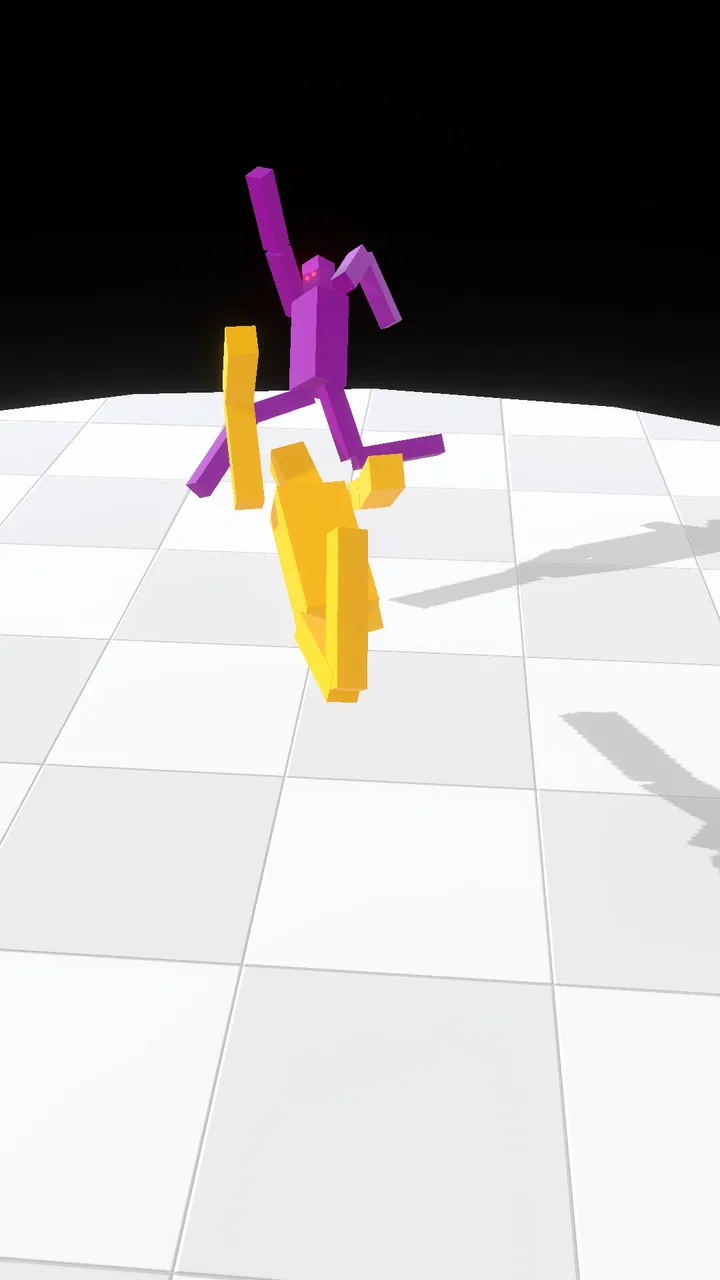
Tackle Battle:Send Them Flying
- 4.5
- Rating
- 5.00M
- Installs
- Free
- Price
 Analysis by App-foxy
I spent time with Tackle Battle:Send Them Flying as a quick-action game built around one clear idea: get physical, tackle opponents, and send them out of the way before they do the same to you. That simplicity is its biggest attraction. You can understand the basic goal almost immediately, yet the short bursts of movement still leave room for timing, positioning, and a little bit of mischief.
This is an action game from KAYAC Inc., and it takes a very different route from story-heavy adventures or precision-focused shooters. There is no need to learn a large world before having fun. Instead, the appeal comes from direct interaction and the satisfaction of turning a well-timed collision into a dramatic knockback. I found it easiest to enjoy when I treated it as a compact game for spare moments rather than as a replacement for a long-form console-style experience.
How the tackle-based action feels in practice
The central mechanic gives every encounter an immediate question: should I move straight toward an opponent, wait for a better opening, or adjust my position so the impact sends them somewhere useful? That decision-making is more important than simply rushing forward. A tackle that lands at the wrong angle can waste an opportunity, while a carefully chosen approach can clear space and change the whole situation.
You May Also Like

 Blood Strike: 2.5 Anniversary
Blood Strike’s Loadouts Turn Every Drop Into a Tactical Gamble
A close look at Blood Strike’s custom loadouts: how fast access to signature weapons reshapes its battle royale rhythm, rewards preparation, and narrows the gap between fights.

 Pandora - Music & Podcasts
Pandora’s Music Is Easy to Start, but Harder to Recover
Pandora’s strength is its low-effort path from a seed to a station. Its weak spot is how much confidence it asks you to place in connection, setup, and quiet recovery.

 8 Ball Pool
 Is Built on Rivalries, Rematches, and Routine
A close look at the rivalries, rematches, shared routines, and unanswered safety questions that turn a quick pool match into a persistent mobile community.

 Samsung Music
’s Quiet Strength Is Playing What You Already Own
Its reach comes less from spectacle than from dependable access to a personal library. That simplicity is both the app’s strongest retention engine and its ceiling.

 AccuWeather: Weather Radar
AccuWeather Review: A Quick, Clear Forecast for Everyday Decisions
For everyday plans, the best forecast is the one you can understand quickly. AccuWeather makes rain timing, radar, and local conditions easy to act on, with a few trade-offs.

 Hill Climb Racing
Why Hill Climb Racing Still Turns Crashes Into One More Run
A tiny car, a bumpy hill and one more upgrade: Hill Climb Racing keeps resurfacing because its simple chaos makes every near-miss feel personal.
More From Our News Desk



What makes the game approachable is that its premise does not need a long explanation. You are not juggling a large inventory, studying complicated character statistics, or memorizing a huge collection of abilities before the action makes sense. The focus stays on contact, momentum, and the result of each collision. For a player who wants to open a game and understand the objective quickly, that is a real strength.
At the same time, the straightforward premise should not be mistaken for unlimited depth. The experience is built around its tackle-and-knockback loop, so anyone looking for a broad campaign, elaborate role-playing progression, or a large variety of combat styles may find the design narrow. I enjoyed the clarity, but I also noticed that the game’s long-term appeal depends heavily on how much pleasure you get from refining one central action.
The most useful habit is to stop treating every opponent as a target that must be hit immediately. I had better results when I watched the surrounding space first. A direct attack may be tempting, but a slight reposition can make the difference between merely touching an enemy and sending them decisively away. That small change in mindset gives the game more tactical character than its short description suggests.
Another practical tip is to think about recovery after a tackle. Even when an impact succeeds, the next moment matters. If you rush into the following engagement without checking your position, you can lose the advantage you just created. I found the safest rhythm was to make one deliberate move, observe the result, and then choose the next approach rather than holding a constant forward charge.
This also makes the game suitable for short sessions. A quick break can be enough to play a few encounters and feel that I have made a decision rather than simply watched an automated sequence unfold. The action is immediate, but the best results come from paying attention to spacing. That combination makes it more satisfying than a purely reflex-based tap game.
What makes the free access worthwhile
The game is free to download, which changes how I judge it. I do not expect the breadth of a premium action title when there is no purchase price to enter. Instead, I ask whether the opening experience gives me a clear reason to keep playing and whether the central mechanic feels enjoyable without requiring a financial commitment. On that basis, the game offers a low-risk way to try a distinctive style of mobile action.
Free access is especially valuable here because the concept can be understood within a short time. You do not need to spend hours learning whether the tackle mechanic suits you. If you enjoy the physical feedback of knocking opponents away, the game can become a convenient pick-up-and-play option. If the idea feels repetitive after a few sessions, you can move on without having paid for a large package built around a mechanic you do not like.
I would still separate free entry from unlimited value. A no-cost game earns its place on my phone by respecting my attention as well as my budget. The repeated collision loop needs to remain enjoyable, and players who expect constant novelty may eventually want more variety than this focused design provides. The financial risk is low, but the time commitment is still something to consider.
The public response suggests that the game has found a substantial audience: it carries an average rating of 4.5 from around 7.9 thousand ratings and has passed 5 million installs. Those figures do not guarantee that every player will enjoy it, but they do indicate that the simple action premise has connected with many mobile users. I see that as encouraging, particularly for a game that does not try to hide its main idea behind layers of menus or explanation.
It is also rated Teen, so I would not automatically choose it for a very young child. The rating is relevant when deciding whether it fits a shared family device or a younger player’s personal phone. For older players, the rating should not be a concern by itself, but it is still useful context when comparing it with lighter, more family-oriented action games.
Small decisions that improve each encounter
One of the less obvious strengths is how much the angle of approach matters. A tackle is not just a button press that produces the same result every time. The surrounding layout and the direction of movement affect whether the impact feels useful. I recommend practicing controlled approaches rather than trying to move as quickly as possible. That helps reveal the difference between an attack that looks active and one that actually improves your position.
A second insight is that patience can be an offensive tool. Waiting briefly may feel passive in an action game, but it can force an opponent into a more predictable line or give you a cleaner moment to commit. This is particularly helpful for players who initially lose by charging into every confrontation. The game becomes less frustrating once you see that restraint is part of the attack rather than a delay between attacks.
There is also a useful distinction between winning a collision and controlling the next exchange. A successful knockback feels rewarding, but it should not automatically trigger another reckless move. I got more consistent results by using the aftermath to reset my position. That workflow—approach, tackle, reassess—makes the action feel deliberate and gives the short sessions a stronger sense of mastery.
These observations are why I would not describe the game as mindless. It is accessible, but accessibility and depth are not opposites. The depth is concentrated in movement choices rather than in a large collection of systems. Players who enjoy improving their timing and reading an encounter can find more to think about than the basic premise implies.
Where the design may start to feel limited
The same focus that makes the game easy to learn can also create friction. If you need a constantly expanding set of objectives, a story with meaningful character development, or a wide range of weapons and abilities, this is probably not the right action game for you. Its identity is tied closely to tackling and knockback, so the experience does not pretend to be a complete substitute for a larger combat adventure.
I also would not recommend it to someone who dislikes repetition in mobile games. Even enjoyable mechanics can lose their impact when the player wants a completely different challenge every few minutes. The game works best when you are happy to revisit the same basic interaction while improving your choices around it. That is a specific taste, not a flaw that affects everyone.
Compared with a conventional fighting game, this feels less focused on memorizing combos and more focused on movement and impact. Compared with a shooter, it removes aiming and weapon management in favor of physical positioning. Compared with a puzzle game, it offers faster feedback and less time to plan. Those comparisons helped me understand its place: it is a compact action experience for players who want direct confrontations without the complexity of a full fighting or shooting system.
Players searching for a premium game with a clearly defined one-time purchase may also prefer a different category altogether. The free model makes trying this game easy, but the value question is mainly about whether the repeated play loop earns a place in your routine. Since I am not paying an entry fee, I judge it by how quickly it creates fun and how long that fun remains fresh for me.
Performance expectations should also be realistic. The game supports devices running Android 6.0 or later, which makes it accessible to a broad range of Android phones and tablets. Compatibility alone does not tell me how every device will feel during play, so I would still consider the age and general capability of a particular phone. On a device that struggles with modern games, a focused action title may be appealing, but smooth control remains important for a game built around timing.
Who will get the most from it?
I think the best audience is someone who wants a free action game that can be understood quickly but still rewards better decisions. It suits players who enjoy short sessions, physical game feedback, and the small satisfaction of turning an opponent’s movement against them. It is also a good choice for anyone who prefers a single strong mechanic over a crowded menu of systems.
A realistic everyday use case is a short pause between tasks. I could imagine opening it while waiting for an appointment, taking a few minutes to focus on a handful of encounters, and closing it without needing to remember a complicated plot or manage a long checklist. The tackle mechanic gives those brief sessions a clear beginning and end, which is useful when I do not have time for a larger game.
It can also work as a casual recommendation between friends who enjoy comparing reactions and approaches. One person may charge aggressively, while another waits for a better line and uses positioning more carefully. Even without turning the experience into a serious competition, that difference in play style gives the simple premise some conversation value.
I would steer story-first players elsewhere. If your favorite part of an action game is meeting characters, exploring a detailed world, or unlocking a long sequence of narrative events, this focused format may feel too bare. I would also suggest a different option for players who want deep customization, complex team building, or a large strategic layer. This game’s strength is not breadth; it is the immediate pleasure of a well-executed tackle.
It is worth noting that the developer is KAYAC Inc., and the current version is 060. Those details help identify the specific release I reviewed, especially for readers comparing versions across devices. The game was released on February 4, 2025, so it belongs to a relatively recent wave of mobile releases rather than an old title being rediscovered years later.
My recommendation after weighing the tradeoffs
I recommend giving Tackle Battle:Send Them Flying a try if you want a free, uncomplicated action game with a distinctive physical hook. The cost of entry is friendly, the objective is easy to understand, and the best moments come from making a tackle at the right time instead of simply pressing forward. I especially like it for short sessions where I want interaction immediately and do not want to maintain a large progression system.
My recommendation becomes more cautious if you need variety above all else. The game asks you to enjoy its central idea repeatedly, and that can be either its charm or its main limitation. I would not install it expecting a full fighting game, a story adventure, or a tactical campaign. I would install it expecting a compact action loop that rewards better positioning and more patient decisions.
The strongest reason to try it is that there is little financial risk in discovering whether the mechanic clicks with you. The strongest reason to skip it is equally straightforward: if tackling opponents and managing the aftermath does not sound enjoyable on its own, additional play is unlikely to change your mind. For me, the balance lands on the positive side because the game makes its purpose clear and gives that purpose enough tactical texture to support repeat sessions.
In the end, I see this as a focused recommendation rather than a universal one. It is a good fit for mobile players who value instant action, readable goals, and the satisfaction of sending an opponent flying through a well-chosen move. It is not the right choice for someone shopping for a large, content-heavy adventure. If you understand that tradeoff, the free download offers a sensible way to test a playful and unusually direct kind of action game.
FAQs for Tackle Battle:Send Them Flying
01What is Tackle Battle: Send Them Flying?
Tackle Battle: Send Them Flying is a casual physics-based action game centered on launching characters through obstacle-filled environments. The main objective is to tackle, hit, or propel targets as far and as effectively as possible while taking advantage of movement, timing, and the surrounding scenery. Its short levels and simple controls make it suitable for quick gaming sessions on mobile devices.
02How do you play Tackle Battle: Send Them Flying?
Gameplay is generally built around controlling the direction, timing, and strength of a tackle or launch. Players must aim carefully, collide with targets, and use platforms, barriers, and other objects to create longer or more successful flights. As stages progress, completing objectives may require better timing and more precise positioning rather than simply attacking as quickly as possible.
03Is Tackle Battle: Send Them Flying free to download?
The game can typically be downloaded without an upfront purchase, although availability and pricing may vary depending on whether you use Android or iOS and on your region. Like many free-to-play casual games, it may include advertising, optional in-app purchases, or both. Before installing, check the store listing for current purchase information, age guidance, and any notes about advertisements.
04Does Tackle Battle: Send Them Flying require an internet connection?
Some parts of Tackle Battle: Send Them Flying may work without a continuous internet connection, especially if you are playing already downloaded levels by yourself. However, an internet connection may be needed for advertisements, updates, cloud-related features, event content, or in-app purchase verification. Offline behavior can also change after updates, so players should not assume every feature will remain available without connectivity.
05Is Tackle Battle: Send Them Flying suitable for children?
The game’s simple controls and cartoon-style physics may make it approachable for younger players, but parents should review the current age rating before downloading it. It is also worth checking whether the app displays advertisements or offers optional purchases. If children use the device, parental controls and purchase restrictions are recommended, particularly because repeated gameplay and reward-based progression can encourage longer sessions.
Pros
- Simple controls make it easy to start playing immediately.
- Short matches are ideal for quick gaming sessions.
- Physics-based launches create amusing and unpredictable moments.
- Bright visuals and playful animations give the game a friendly style.
- Progression rewards experimentation with different attack angles.
Cons
- Gameplay can become repetitive after mastering the main launch mechanic.
- Some levels depend heavily on timing and luck.
- Ads may interrupt the experience between rounds.
- Limited strategic depth may not satisfy competitive players.
- The game may require extra storage for updates and downloadable content.

Tackle Battle:Send Them Flying
Gallery